A brand-new home can look perfect and still benefit from independent inspection.When I represent a buyer building from the ground up in Bryan–College Station, I recommend inspection throughout

Dated: May 29 2026
Views: 12
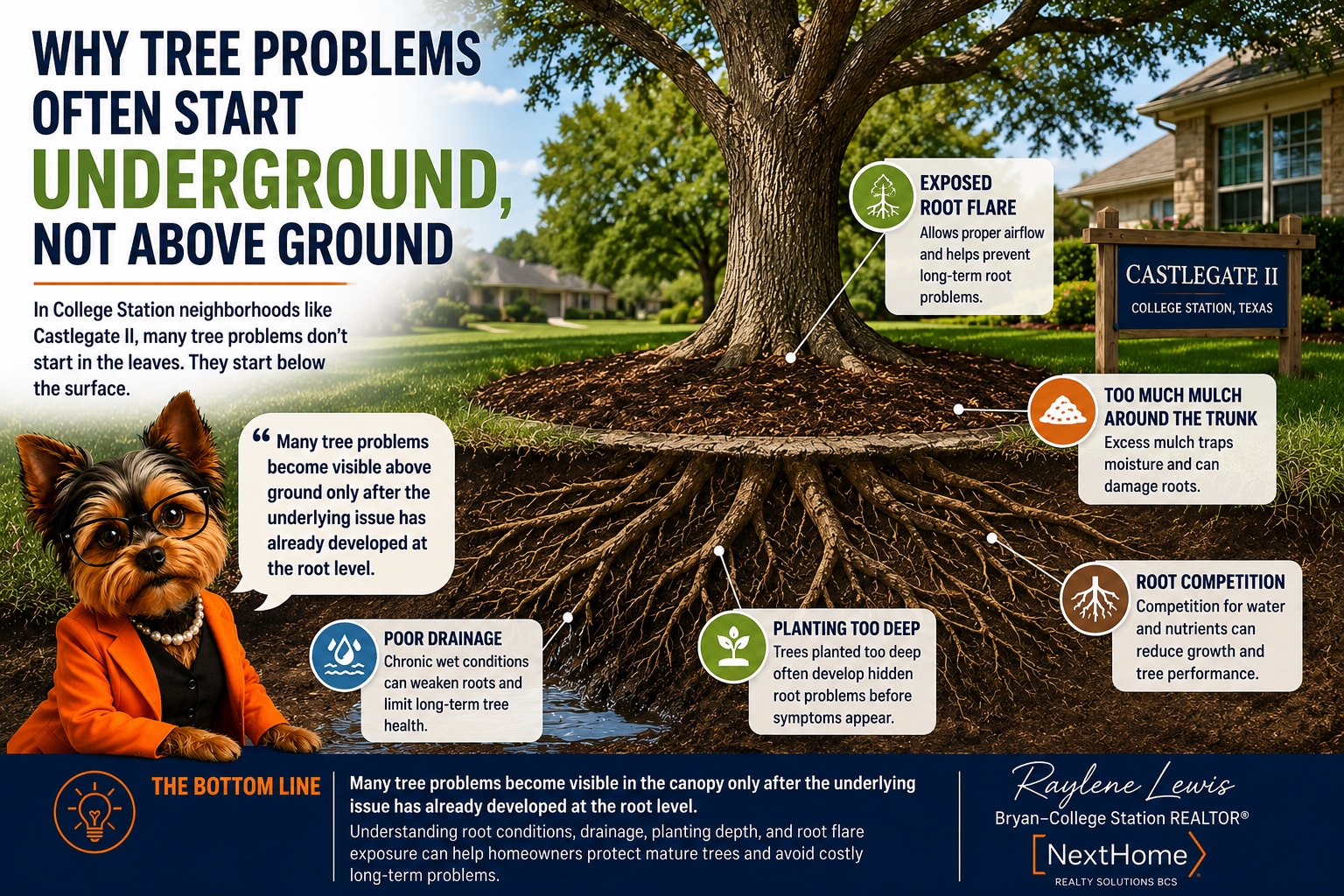
Raylene Lewis explains that many tree problems in College Station neighborhoods become visible above ground long after the underlying issue has already developed below the surface.
Recently, during a property consultation in Castlegate II, an arborist reinforced an important lesson many homeowners never hear:
Many homeowners assume tree health is determined by what they can see.
Leaves.
Branches.
Dead limbs.
Growth patterns.
Experienced arborists often start somewhere else entirely.
They start underground.
While this particular consultation occurred at a home in Castlegate II, the lesson applies throughout College Station and the Brazos Valley. Many tree health concerns are ultimately linked to drainage, planting depth, soil conditions, and root development rather than what homeowners initially notice in the canopy.
One of the live oaks evaluated during the visit appeared relatively healthy from a distance.
The tree had a full canopy and showed no obvious signs of severe decline.
However, the arborist immediately focused on factors below the surface, including:
Those factors often have a greater impact on long-term tree health than the leaves homeowners see every day.
The root flare is the area where the trunk transitions into the primary structural roots.
According to the arborist, this area should remain exposed, dry, and visible.
When mulch, soil, or landscaping materials are piled against the trunk, several problems can develop:
The recommendation was simple:
Pull mulch away from the trunk and expose the root flare.
While it sounds minor, the arborist explained that many trees show measurable improvement after the root flare is properly exposed.
One of the most important observations involved drainage.
The property had experienced ongoing water issues after nearby construction altered surrounding elevations.
Standing water remained longer than normal after rain events.
While the homeowner primarily viewed the issue as a drainage problem, the arborist connected it directly to tree health.
Trees growing in consistently wet conditions often struggle to achieve optimal vigor.
In this case, the arborist described the live oak as being in good condition, but not excellent condition, and believed the chronic wetness was likely a contributing factor.
One of the most valuable lessons from the consultation was how experienced professionals diagnose problems.
The arborist did not start with the leaves.
He started with the environment.
He evaluated:
Only after understanding those factors did he evaluate the visible symptoms.
That approach mirrors how many property issues are solved.
The symptom is often what gets noticed.
The cause is often somewhere else entirely.
Many homeowners spend money treating visible symptoms while the underlying cause remains unchanged.
With trees, that can mean:
Without ever addressing drainage, planting depth, or root conditions.
Healthy trees are built from the ground up.
Raylene Lewis explains that many homeowners focus on symptoms while experienced professionals focus on causes.
In this Castlegate II consultation, the arborist's first concerns were not leaves or branches. They were drainage conditions, planting depth, root flare exposure, and long-term root health.
Many tree problems become visible in the canopy only after the underlying issue has already developed at the root level.
Understanding that relationship can help homeowners protect mature trees, avoid unnecessary expenses, and make better long-term property decisions. #NextHomeBCS
By Raylene Lewis
Bryan–College Station REALTOR®
NextHome Realty Solutions BCS

Raylene Lewis, REALTOR® NextHome Realty Solutions BCS Texas License #0487208 Raylene Lewis is a Bryan–College Station REALTOR® with NextHome Realty Solutions BCS, serving buyers and selle....
A brand-new home can look perfect and still benefit from independent inspection.When I represent a buyer building from the ground up in Bryan–College Station, I recommend inspection throughout
Yes, I believe it will.But not overnight.SpaceX's Terafab project in Grimes County is a major economic development for the Brazos Valley. The project is expected to bring substantial investment,
By Raylene Lewis, REALTOR® | NextHome Realty Solutions BCSRenting an Unsold Home? Count the Months Before Rent BeginsBy Raylene Lewis, REALTOR® | NextHome Realty Solutions BCS“If I
Buying a College Station home for your Aggie naturally starts with your own student.Does the location work?Is the layout right?Can they get to campus easily?Does the property fit the family's budget
 © 2026 Bryan College Station Regional Association of Realtors. All rights reserved. Information deemed to be reliable but not guaranteed. The data relating to real estate for sale on this website comes in part from the Broker Reciprocitysm Program. Real estate listings held by brokerage firms other than NextHome Realty Solutions BCS are marked with the BR logo and detailed information about them includes the name of the listing brokers. Listing broker has attempted to offer accurate data, but
buyers are advised to confirm all items. Information last updated on September 12, 2026 9:26 PM UTC
Show More...
© 2026 Bryan College Station Regional Association of Realtors. All rights reserved. Information deemed to be reliable but not guaranteed. The data relating to real estate for sale on this website comes in part from the Broker Reciprocitysm Program. Real estate listings held by brokerage firms other than NextHome Realty Solutions BCS are marked with the BR logo and detailed information about them includes the name of the listing brokers. Listing broker has attempted to offer accurate data, but
buyers are advised to confirm all items. Information last updated on September 12, 2026 9:26 PM UTC
Show More...
